Tree work near utilities requires early identification of ownership, energized conductors, qualified personnel, approach limits, access, service continuity, and stakeholder responsibility.
Treat utility proximity as a planning issue
Overhead and underground utilities affect how a tree can be inspected, pruned, removed, rigged, accessed, and replaced. They should be identified during scope development, not after the crew and equipment arrive. The owner, utility, tree contractor, excavation contractor, and public authority may each control different parts of the work.
Begin by locating overhead conductors, service drops, transformers, communication lines, meters, underground markings, easements, poles, guy wires, cabinets, and access routes. Do not infer that a line is de-energized because it is insulated, small, or attached to a residence. Utility status must be established through the responsible utility and qualified personnel.
Know who owns and controls the line
A utility distribution line, customer service drop, telecommunications line, private lighting circuit, and underground service can have different owners and procedures. Property owners should contact the utility when vegetation is touching or may enter required clearance from energized conductors. The utility can explain responsibility and any required coordination.
The property owner's preferred tree company may be able to perform part of the project while the utility handles another part. In other cases, line-clearance-qualified workers or a planned outage may be required. Never assume that ordinary arboricultural experience alone authorizes work within an electrical hazard zone.
Electrical hazards change the work method
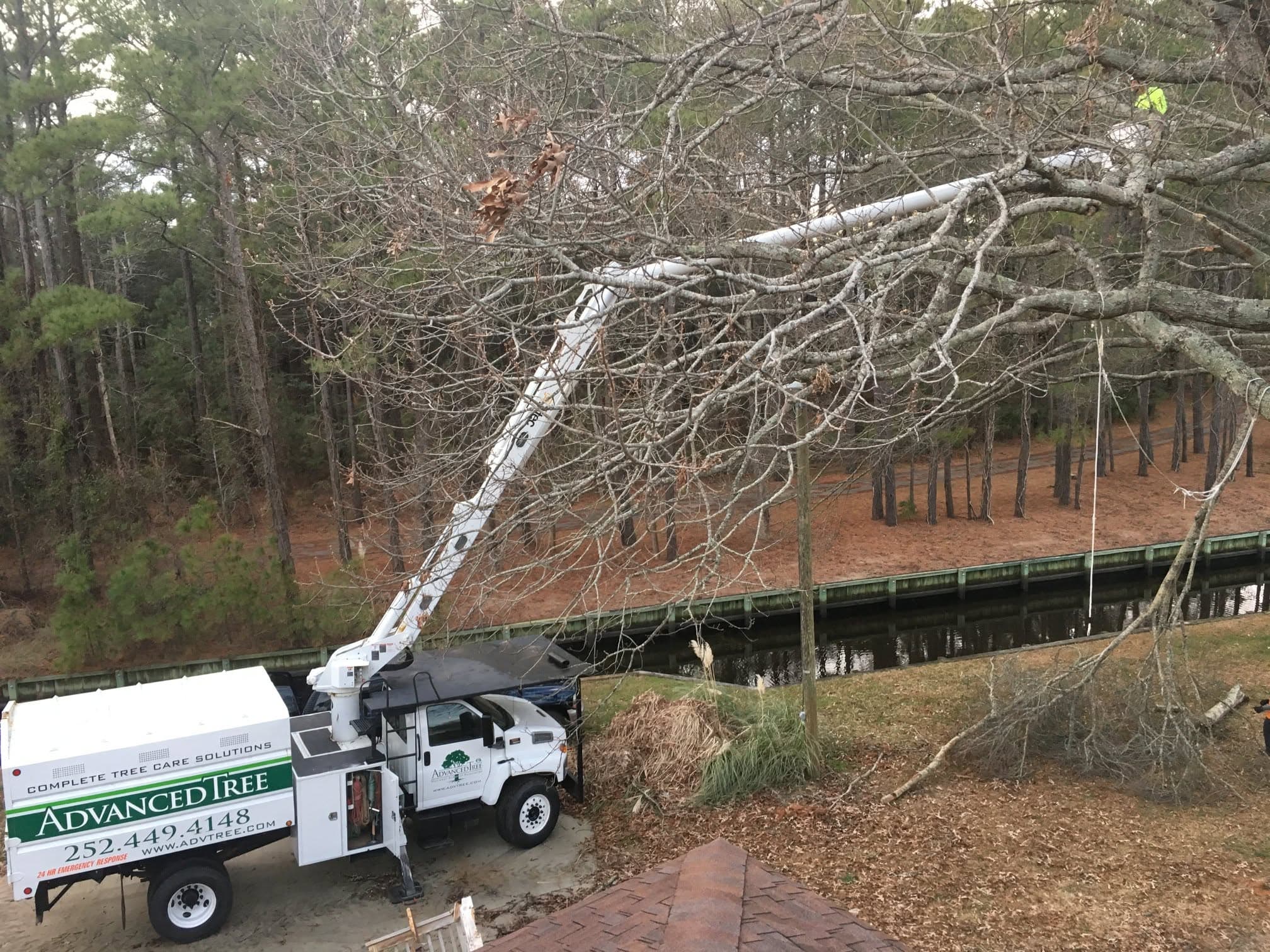
Branches, tools, ropes, equipment booms, and workers can create a path to energized conductors. Electrical contact does not require a saw blade to touch a bare wire. OSHA rules distinguish qualified line-clearance tree trimmers and set requirements for training, minimum approach, communication, and operations near electric power.
Property owners and unqualified workers should stay away from downed lines, trees in contact with conductors, and branches that could move into a line during cutting. After storms, treat all conductors as energized until the utility states otherwise. Keep others out of the area and report the condition.
Underground utilities matter too
Stump grinding, excavation, anchoring, crane setup, mats, and equipment travel can affect underground systems. Public utility locating services identify participating facilities, but private lines such as irrigation, lighting, septic controls, generators, propane, or owner-installed communication may require separate information or private locating.
Mark known facilities, communicate tolerance zones, and confirm the planned depth and footprint of stump or root work. Grinding below grade and full excavation are different scopes. If the requested work approaches a marked facility, stop and coordinate rather than relying on an approximate map or memory.
Access and service continuity shape the schedule
Utility work may require lane control, parking restrictions, outages, resident notification, escort, locked-facility access, or coordination with multiple crews. Identify who can approve shutdowns and who notifies affected users. For commercial, municipal, or HOA properties, service interruptions can affect life-safety systems and operations.
Equipment setup must preserve required clearance and stable ground while maintaining access for utility and emergency personnel. A plan may need alternate staging, smaller equipment, climbing, controlled rigging, or phased work. Convenience should not override electrical or site-control requirements.
Pruning objectives should be clear
Utility clearance is not a license to top or indiscriminately shear trees. The objective, responsible party, required clearance, growth response, species, branch structure, and future maintenance should be understood. Directional pruning can guide growth away from conductors when performed appropriately, but not every tree is compatible with its location.
Where repeated clearance would leave poor structure or an unsustainable canopy, removal and replacement may deserve consideration. Replacement selection should account for mature size, utility location, soil, exposure, and available growing space so the same conflict is not recreated.
Put coordination in the written scope
Identify which party contacts the utility, provides locates, secures permits, supplies traffic control, authorizes an outage, grants easement access, and restores disturbed areas. State whether work is contingent on utility action or private locating. Unassigned coordination is a common source of delay and unsafe improvisation.
At closeout, document the work completed, deviations, remaining concerns, and future maintenance. Utility vegetation management is ongoing. A clear record helps the next owner, manager, utility representative, and tree contractor understand what has already been decided.